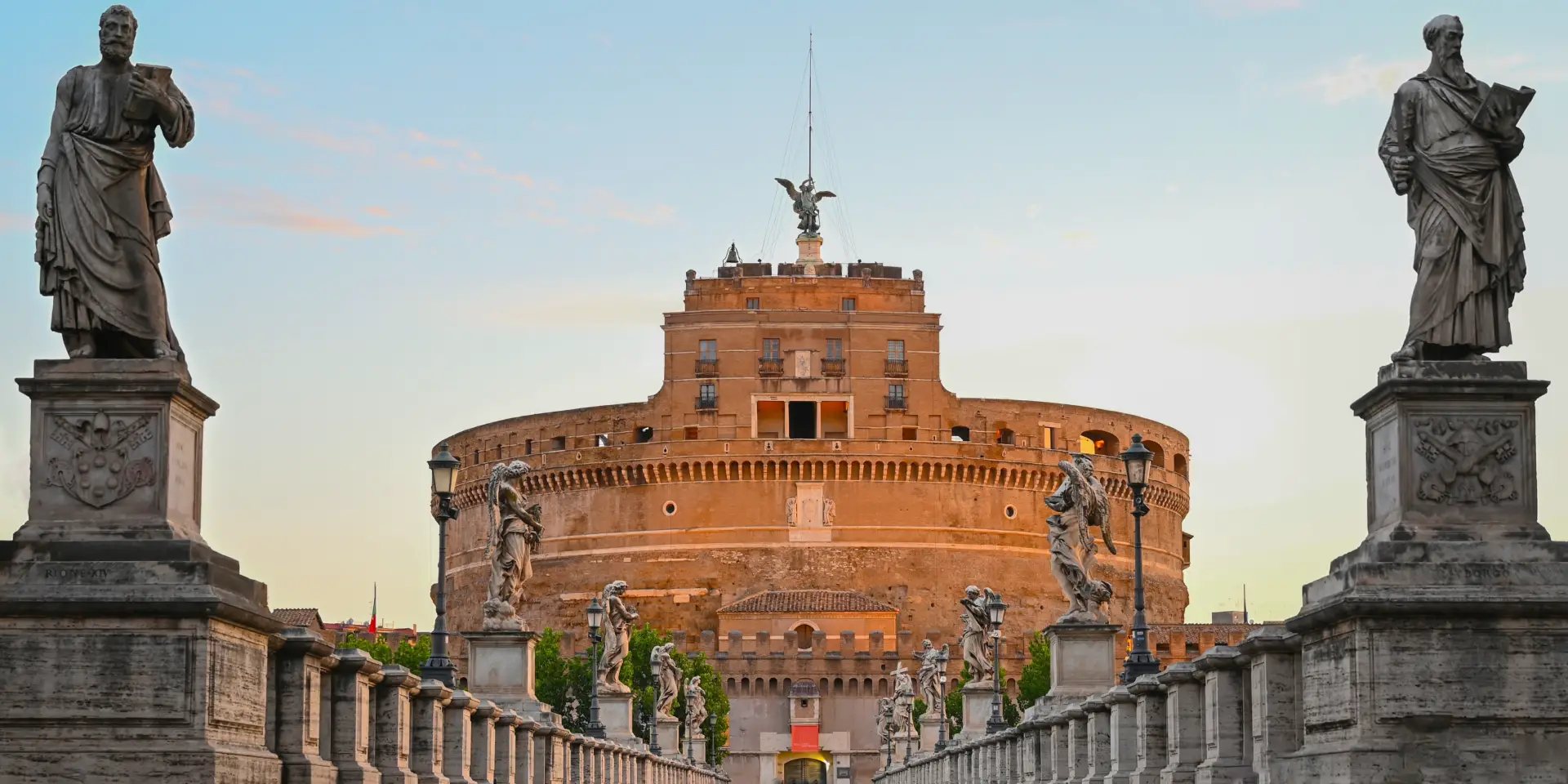

Stand before the round stone mass of The Mausoleum of Hadrian—better known today as Castel Sant’Angelo—and step into a building that became Rome’s memory palace. From its base on the Tiber, this cylindrical landmark leads you upward through spaces that once guarded imperial remains, later sheltered popes, and now house the national museum. The route is a quiet ascent from austere corridors to frescoed rooms, ending in open air with views that stretch toward Vatican City and the historic center.
What awaits inside this layered Roman monument today
Your visit unfolds like a timeline you can walk. Lower levels evoke the original tomb of Hadrian with thick masonry and barrel-vaulted passages. As you climb, the character shifts to fortress and residence: defensive lookouts, ceremonial chambers, and rooms where power once lived behind guarded doors. Throughout, the museum presents arms, decorative arts, and architectural fragments in ways that illuminate the building rather than distract from it.
A helical ramp sets the rhythm of movement. It carries you to the heart of the mausoleum and onward to rooms adapted in the Renaissance, where ceilings bloom with painted allegories and fireplaces display papal insignia. The story remains architectural at its core: the circular plan, the tightening and release of space, the way light changes stair by stair. Exhibitions slot into this sequence so the narrative stays coherent while you explore.
Highlights, route flow, and terrace panoramas
Expect rewarding contrasts. Dim corridors open to bright salons; arrow slits widen into vistas of the river; Latin inscriptions whisper from stone while frescoes announce myth and authority. The route culminates on the upper terrace, where the bronze archangel overlooks Ponte Sant’Angelo. From here the skyline explains the fortress: the bridge, the river’s bend, and the domes beyond. It’s the moment that connects the museum to the city it guarded.
This ticket is built for self-guiding. The downloadable audio guide app keeps directions simple and context clear, letting you pause for photos or replay stops when a room is busy. Languages include English, Italian, French, German, Spanish, and Chinese, so mixed groups can follow along without losing pace. Families appreciate concise tracks; design lovers enjoy callouts to thresholds, cornices, and restored details that are easy to miss unaided.
Practicalities are straightforward. You choose a date and preferred time and are assigned the closest available entry; the confirmed slot can vary slightly, so always check your voucher. You’ll receive a separate email with instructions to download the digital audio guide to your device. The museum indicates wheelchair access; as with most historic sites, some floors include inclines and uneven surfaces—staff can point out the smoothest path to upper levels and viewpoints.
Ready to secure your visit to this landmark on the Tiber? Book timed entry with the audio guide app on Tiqets and follow the ascent from tomb to terrace at your own pace.